Original: $226.28
-65%$226.28
$79.20The Story
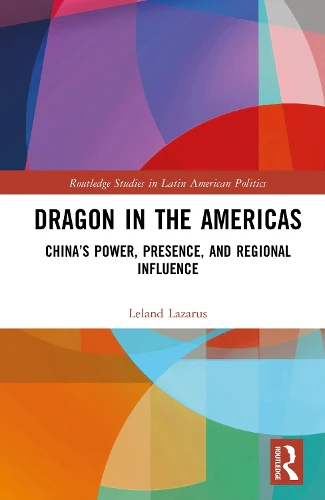
Dragon in the Americas: China’s Power, Presence, and Regional Influence offers a sweeping, on-the-ground analysis of how China is reshaping Latin America and the Caribbean across trade, technology, security, and geopolitics--revealing growing strategic competition in the Western Hemisphere.
Drawing on original research, fieldwork, and policy experience, the book moves beyond simplistic “China threat” or “White Knight” development partner narratives to uncover a far more complex reality. It examines China’s effort to establish "strategic support points" via ports and the Panama Canal, digital infrastructure, space cooperation, critical minerals, and security partnerships, while also exposing the darker undercurrents of transnational crime and illicit finance. It also highlights the region as a key diplomatic battleground between China and Taiwan. Grounded in international relations and dependency theories, the book highlights how Beijing increasingly blends economic engagement with strategic ambition, even as Latin American and Caribbean countries exercise agency—balancing China, the United States, and their own development goals The result is a nuanced, data-driven framework for understanding power, dependency, and sovereignty in a rapidly evolving region.
This book is essential reading for policymakers, business leaders, and scholars of international relations, as well as anyone seeking to understand the future of U.S.–China competition and Latin America’s pivotal role within it.
Description
Dragon in the Americas: China’s Power, Presence, and Regional Influence offers a sweeping, on-the-ground analysis of how China is reshaping Latin America and the Caribbean across trade, technology, security, and geopolitics--revealing growing strategic competition in the Western Hemisphere.
Drawing on original research, fieldwork, and policy experience, the book moves beyond simplistic “China threat” or “White Knight” development partner narratives to uncover a far more complex reality. It examines China’s effort to establish "strategic support points" via ports and the Panama Canal, digital infrastructure, space cooperation, critical minerals, and security partnerships, while also exposing the darker undercurrents of transnational crime and illicit finance. It also highlights the region as a key diplomatic battleground between China and Taiwan. Grounded in international relations and dependency theories, the book highlights how Beijing increasingly blends economic engagement with strategic ambition, even as Latin American and Caribbean countries exercise agency—balancing China, the United States, and their own development goals The result is a nuanced, data-driven framework for understanding power, dependency, and sovereignty in a rapidly evolving region.
This book is essential reading for policymakers, business leaders, and scholars of international relations, as well as anyone seeking to understand the future of U.S.–China competition and Latin America’s pivotal role within it.